There's nothing quite as
stunning as a well developed back: muscles twisting everywhere sort of a
road map, wide lats sort of a jet , and therefore the lower back lit up
sort of a Christmas tree.
For me, a defined, fully developed back is altogether one amongst|one in
every of one among the foremost amazing things in all if bodybuilding.
Historically, people always say Samir Bannout was the primary
bodybuilder to obviously show the lower back (erector spinae) muscles in
competition—this would be 1982 and 1983, the year he won the Olympia.
There's a picture of Arnold from his peak years within the 70's in his
Encyclopedia that clearly shows the erector spinae muscles, defined and
reminding me of Christmas morning! actually , his entire back looks
amazing therein picture! Regardless, both men had great backs.
Moving forward in history, quite few top guys are known for nice backs:
Lee Haney, who was known for his great lat width; Dorian Yates, Flex
Wheeler, Ronnie Coleman, and Dexter Jackson to call just a couple of .
For me, a defined, fully developed back is one of the most amazing things in all if bodybuilding.
In fact, a weak back, whether you compete or not, is a pretty serious
weak point that makes a big difference in how you look. After all, what
kind of bodybuilder doesn't have wide, flaring lats? Of course, the
back has to be thick as well. And let's not forget the traps, what good
is a weak most muscular pose?
Training the back can be quite a challenge because many people cannot
feel the back muscles working when they train. This is very common
because you can't see the back and your biceps are heavily involved in
all back exercises. Many times you get a great biceps pump and little
else.
The secret to taking the biceps out of the picture is to visualize
them as hooks. The other secret is to begin all movements with the back
muscles instead of pulling with the arms.
If you've been training long enough (you can flex any muscle at will)
you start any back exercise by flexing the back and pulling with the back muscles first. By doing this, you will feel the back muscles working. If this continues to be a problem, you can try two things: a
thumbless grip and/or lifting hooks. Both of these options can take the
biceps out of it, putting more stress on the back.
Back Anatomy
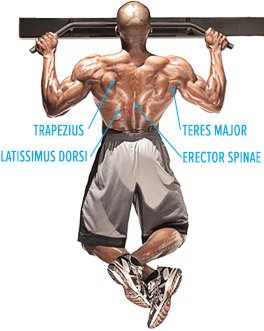
Knowing what a muscle does is critical to training it correctly—with that in mind let's take a look at the anatomy of the back:
Trapezius
This is a very wide triangular shaped muscle that covers almost all
of the muscles at the nape of the neck and a large part of the back. It
originates in the occipital bone at the base of the skull and is
inserted in the scapula and clavicle. The fibers of this muscle provide
pull in three directions: up, down and in. Its function is to turn the
head and raise the shoulders.
Many people train traps with shoulders—I prefer this myself, but for the purpose of this article I'll include it with back.
Rhomboideus Major/Rhomboideus Minor
The rhomboids originate on the spinal column and attach to the middle
of the scapula. Their function is to bring the scapula in towards the
spine, literally meaning to squeeze the shoulder blades together.
Teres Major
This muscle originates on the outer edge of the scapula and attaches to the humerus. It serves to pull the arm back.
Latissimus Dorsi
This is the largest muscle of the back. Fan or "V" shaped, they
provide force in a number of body positions, these same positions can be
duplicated on a pulldown machine using varying angles, that is, you can
pull straight down, or in any leaning back position.
They are attached to the upper end of the humerus and run down the
vertebral column and pelvic girdle. The function of this muscle is to
pull the arm downward. If the arm is in a fixed position, then the lats
can pull the arm upward.
Erector Spinae
A group of muscles that give support to the spinal column. These
muscles are: the longissimus, the spinalis and the iliocostalis. The
function is to extend the spine.
As you can see, the back is quite complicated. Yet, there are two
main types of movements that work the back: pulldown movements and
rowing movements. Then there are power moves, like the deadlift, snatch
and power clean. These moves are more of a whole body exercise; they
work much more than the back.
I've always been a big believer in including at least one of these in
your routine, not only because of all the muscles they work, but also
because of the fact they cause a dramatic increase in the body's natural
production of anabolic hormones such as testosterone and growth
hormone.
The Split
While it's normal to place chest and back together on an equivalent
training day—Arnold wont to do this—it makes more sense to figure back
on it's own day, followed by biceps and forearms. this enables you to
focus all of your energy on back training only rather than "sharing"
energy with another big muscle group just like the chest.
Since the biceps are actively involved altogether back exercises it is
sensible to figure biceps after back. i prefer to incorporate forearms
with this workout but there's a theory that forearms are a touch like
abs therein you'll work them more often then other muscles. While
they're high endurance muscles that are involved in every exercise you
are doingdue to the grip required to carry the bar, I like better to
work them hard once every week with biceps.
If you recognize my writing you recognize i think in one workout per
week per muscle group. this is often due to my age and recovery ability
and since I'm natural.
Age and steroid use can change everything however, so I imagine younger
guys and gals on steroids use more typical splits, hitting each muscle
twice every week . That's fine if it works for you, just make certain
you're fully recovered.
Remember growth only happens once you recover, not from how often you hit the gym.
5 Sample Routines
Performance Notes
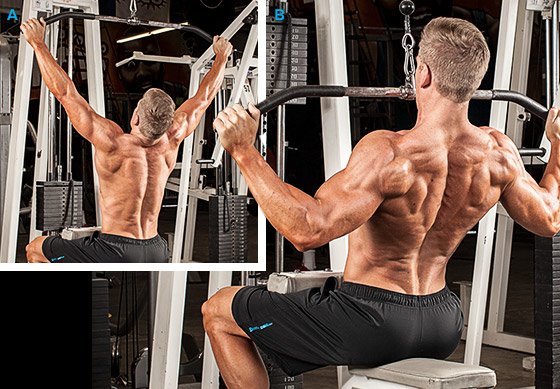
Deads should be explosive but under complete control up and slow on
the way down. Use a full range of motion on chins, concentrating only on
the back, not the biceps. Remember, they are hooks, nothing more. On
bent rows—explosive up, hold and squeeze at the top, lower slowly.
Referenses:

Comments
Post a Comment